
KBC/KBC voted Best Bank in Belgium for a staggering sixth time in a row
- KBC Group wins Euromoney Award for 'Best Bank in Belgium'
- Thanks for putting your trust in us


Capital gains realised on the sale of financial products will be taxed at a rate of 10% with effect from 1 January 2026.
Since 1 June, KBC Brussels automatically withholds the 10% capital gains tax, unless you’ve opted out.
Read on to find out what this tax entails and what KBC Brussels will do to help and support you.
The tax applies to:
This means that the tax does not apply to:
The capital gains tax has a very broad scope of application. It covers different types of both Belgian and foreign financial products, including shares, bonds, funds, options, trackers, ETFs, warrants, savings-linked insurance, investment-type insurance, gold, foreign currency and crypto assets, both listed and unlisted.
Capital gains tax does not apply to:
1. Capital gains
The capital gain is the difference between the amount you receive when selling the product and the amount you paid when purchasing the product. As the new tax entered into force on 1 January 2026, only capital gains accrued on or after that date will be affected. To determine the price of products you have bought before that date, we look at the value of the product on 31 December 2025 (known as the ‘snapshot value’).
Deduction of costs or taxes to reduce the realised capital gain is not permitted.
Example
You bought a share in 2023 at a price of 100 euros, and sell it on 15 September 2026 for 150 euros. Over the entire period, you therefore realise a capital gain of 50 euros. However, the price of the share on 31 December 2025 was 120 euros. As a result, you pay only 10% of 30 euros (150 euros - 120 euros) in tax.
2. Capital losses
It is possible that in addition to capital gains in a given year, you also realise capital losses. You can deduct these capital losses from the capital gains you realised in the same year, across different types of investments.
Important limitations:
When calculating a capital loss, we always use the value on 31 December 2025 (known as the ‘snapshot value’). Anything that happened before that date is no longer taken into account. This also means that historical losses (losses realised up to and including 31 December 2025) cannot be deducted from capital gains realised in that income year.
Example
The capital loss is 100 euros - 80 euros = 20 euros
The loss of 50 euros (150 euros - 100 euros) cannot be set off against a realised capital gain on another investment in 2027.
The capital loss of 20 euros can be set off against your realised capital gain from the same calendar year.
Example of annual offsetting of capital gains and losses
In 2027, you realise a:
Net taxable capital gain:
25 000 euros - 3 000 euros = 22 000 euros (leaving aside any exemptions)
3. Historically higher acquisition value
You may take into account your historical purchase price, i.e. the price you paid before 31 December 2025.
If you have made multiple purchases of the same security, you apply the average purchase price.
You may use the most favourable value when calculating the capital gain:
Some other points to consider:
Example
Excluding the historical acquisition value: 125 euros - 120 euros = 5 euros of taxable capital gain
Including the historical acquisition value: 125 euros - 150 euros = no profit, 0 euros of taxable capital gain
4. What about purchases at different times?
If the same product was purchased at different times, the calculation of the capital gain is based on the securities purchased first (FIFO principle: first in, first out). This means that, for the calculation of the capital gains tax, the product purchased first is also the first product to be sold.
Example
Capital gain on the sale in 2028:
1. Capital gains
For savings-linked and investment-type insurance products (guaranteed-interest life insurance (class 21) and unit-linked life insurance (class 23)), we look at the difference between the current value of your investment and the total amount you have invested over time.
The new tax applies as from 1 January 2026. For amounts invested before then, the value of the entire investment in your insurance contract on 31 December 2025 will be used. This snapshot value constitutes the basis for the calculation.
Capital gains tax is not applicable in the event of a distribution due to the death of the insured.
Example
Your investment is worth 120 000 euros today. The snapshot value on 31 December 2025 was 100 000 euros.
2. What if you only withdraw a part of your investment?
If you withdraw just part of your investment, a proportionate amount of your total capital gain will only be taxed as well.
Example
Your investment is worth 100 000 euros. Your total capital gain is 20 000 euros.
You withdraw 30% of that amount.
3. Capital losses
It is possible that in addition to capital gains in a given year, you also realise capital losses. You can deduct these capital losses from the capital gains you realised in the same year, across different types of investments. They cannot be carried over from one year to the next.
As capital gains are taxed as from 1 January 2026, capital losses can also be deducted from that date.
You can only set off capital losses in your tax return. If, as intermediary, KBC Brussels withholds the 10% capital gains tax for you, it may not take into account the capital losses you have realised.
Example
In 2027, you realise a total capital gain of 25 000 euros by selling various investments. You also sell some investments in the same year on which you realise a total loss of 3 000 euros.
The net taxable capital gain is then 25 000 euros - 3 000 euros = 22 000 euros (leaving aside any exemptions).
4. Historically higher acquisition value
If the value of your previous purchase was higher than the snapshot value on 31 December 2025, you may apply the higher purchase price instead of the snapshot value.
This option only applies to sales on or before 31 December 2030, and you must state this higher purchase price in your tax return.
However, using a historically higher acquisition value can never result in realising a capital loss. The taxable capital gain will then be reduced to 0 euros.
Example
The purchases you made prior to 2026 amount to 120 000 euros, the snapshot value is 100 000 euros. In 2027, your investment is worth 110 000 euros.
You may use 120 000 euros as the basis for the calculation, meaning that the taxable capital gain is 0 euros.
5. What about purchases made at different times?
For savings-linked and investment-type insurance products, your investment is taken as a whole for the calculation. There is, therefore, no need to apply the FIFO (first in, first out) principle or to perform a separate calculation each time a purchase has been made.
Example
You invested 20 000 euros in 2026, 30 000 euros in 2027 and 10 000 euros in 2028 (60 000 euros in total). In 2029, your investment is worth 75 000 euros.
1. How is the capital gains tax applied to securities in foreign currencies?
For financial products in foreign currencies, the law provides that both the purchase price and the sale price must be converted into euros using the exchange rate on the day of purchase and sale to calculate the taxable base. This ensures that not only the capital gain on the security itself but also the capital gain on the exchange rate is taken into account for the capital gains tax.
The financial institution is responsible for calculating the correct taxable base for securities in foreign currencies.
Example
2. What about cash in foreign currencies?
The taxpayer is legally obliged to personally declare any capital gains realised on foreign currencies held in an investor’s account, time deposit account or Bolero account in their tax return.
The capital gains must be calculated using the FIFO (first in, first out) principle. The amount deposited into the account first must also be used first to finance a payment, for example.
As this specific provision is still subject to change, we will inform you about the final calculation method at a later date.
3. What happens if you transferred securities from another bank?
We need to know the price you purchased your securities at and the date you purchased them on in order to calculate the capital gains tax correctly. You will find this information in a portfolio statement, a MiFID report or your purchase statement. If you don’t provide us with this information, we will calculate the capital gain on the full sale price.
Some banks have committed themselves to forwarding this information upon a transfer of securities. If your bank is in the list, you don’t have to provide this information yourself. The list will be updated in the future and can be viewed here.
4. What is the Reynders tax?
The Reynders tax is a tax of 30% on the ‘capital gain’ on certain investment funds that invest fully or partially in bonds.
The law provides for a specific method of calculating the new capital gains tax for funds that are subject to the Reynders tax.
So, when selling an investment fund subject to this tax, you are liable to two taxes:
Example
You buy into a fund in 2026 for a price of 2 000 euros. You sell this fund in 2028 for 2 500 euros. The capital gain is then 500 euros.
Say that the TIS (i.e. the part of the gain derived from the interest component) was 120 euros at the time of purchase and 160 euros at the time of sale, the difference (160 euros - 120 euros = 40 euros) is subject to the Reynders tax of 30%.
So, when selling this fund, you pay the following total amount:
5. What about bonds?
The rules for calculating investment income and withholding tax deductions remain unchanged, but there are certain details bond investors should be aware of.
One type of tax per income
Income from bonds can be taxed in different ways:
Income is never taxed twice, so you won’t pay both withholding tax and capital gains tax on the same income.
Sale and redemption of bonds
The sale of a bond may be subject to capital gains tax. The redemption of a bond at maturity is also considered a sale for tax purposes.
The importance of the purchase and sale price
Bonds in foreign currencies
When you invest in bonds denominated in another currency, in addition to the gain or loss on the bond itself, you can also realise a gain or loss on the foreign currency.
Two reference points are used to calculate the capital gain or loss on the exchange rate:
The difference between these two exchange rates determines the realised capital gain or loss on the foreign currency.
Your total capital gain or loss combines both.
Every taxpayer is entitled to an annual exemption. No capital gains tax is payable on the first 10 000 euros of capital gains realised. This amount is indexed annually. You need to arrange this exemption in your personal tax return.
In addition, you can carry forward a limited proportion of the exemption you don’t use to the following year. For each year that you don’t make use of this exemption, you can carry forward up to 1 000 euros to a subsequent year, up to a maximum of five years. This makes it possible for each taxpayer to claim a maximum exemption of 15 000. A married couple could therefore end up with a joint basic exemption of 30 000 if they carry forward the full exemption amount (assuming their investments form part of their joint assets).
Example 1
Year | Net capital gain | Exemption carried forward | Basic exemption | Taxable capital gain |
2026 | 0 | 0 | 10 000 | 0 |
2027 | 0 | 1 000 | 10 000 | 0 |
2028 | 20 000 | 2 000 | 10 000 | 8 000 |
You don’t realise any capital gains in the first two years. As a result, you can carry forward an exemption amount of 1 000 euros twice, and by 2028 your exemption has increased from 10 000 to 12 000 euros.
In 2028, you realise a capital gain of 20 000 euros. Your exemption is 12 000 euros, which reduces your taxable capital gain to 8 000 euros. Since you have now used the full exemption, no exemption amount can be carried forward to the next year.
Example 2
Year | Net capital gain | Exemption carried forward | Basic exemption | Taxable capital gain |
2026 | 0 | 0 | 10 000 | 0 |
2027 | 7 500 | 1 000 | 10 000 | 0 |
2028 | 12 500 | 0 | 10 000 | 2 500 |
You didn’t realise any capital gains in the first year and you can carry forward the exemption of 1 000 euros to the next year.
In 2027, you realise a capital gain of 7 500 euros. You first use the exemption amount of 2026 that was carried forward and then 6 500 euros of your basic exemption. Since you have now used the first tranche of 1 000 euros of your exemption, no exemption amount can be carried forward to the next year.
In 2028, you realise a capital gain of 12 500 euros and your exemption is 10 000 euros (your basic exemption), which means that your taxable capital gain is reduced to 2 500 euros. Since you have now used the full exemption, no exemption amount can be carried forward to the next year.
1. How do you pay capital gains tax after 1 June 2026?
The law provides two ways to pay capital gains tax:
Option 1: Declare everything yourself (opt-out)
How do you make this choice?
Option 2: Automatic deduction (withholding tax)
How do you make this choice?
You don’t have to do anything for this option.
Tax cannot be deducted at source for certain financial products (such as capital gains on crypto assets, foreign currency and gold). For these products, you are responsible for declaring any capital gains in your personal tax return.
For securities that you hold outside Belgium, you will also have to declare the realised capital gains yourself in your personal tax return.
For non-profit organisations and foundations, the system of deducting the tax at source does not apply; instead, payment of the capital gains tax is arranged directly through the legal entities’ withholding tax return.
Hold an account jointly with other people?
Every account holder has to make the same choice (declare everything yourself or opt for automatic deduction).
2. How do you pay capital gains tax realised during the transitional period from 1 January 2026 to 31 May 2026?
The tax applies from 1 January 2026, but a transitional arrangement was in place until 31 May 2026. The legislature provides the option to pay the 10% capital gains tax built up during the transitional period through your bank.
KBC is here to support you
From 7 September, customers who carried out transactions subject to capital gains tax during the transitional period between 1 January 2026 and 31 May 2026 (and who have not requested an opt-out) will receive an invitation to pay this tax through KBC.
You will receive a payment invitation stating the amount owed for each custody account of which you are the holder or co-holder and/or for each insurance policy of which you are the beneficiary. The final payment date is 15 October 2026.
There is no obligation to make payment through KBC.
If you choose to pay the amount owed through KBC and do so on time, you will no longer need to include your realised capital gains in your tax return for income year 2026.
If you do not use this option to pay through KBC, the realised capital gains must be included in your tax return for income year 2026. In that case, the realised capital gains are also subject to the 10% rate.
Whether or not you use this option, KBC will support you by providing a general overview of your realised capital gains and losses in 2027. This will allow you to use the exemption if desired.
The capital gains tax applies from 1 January 2026; we use the snapshot value of 31 December 2025 to calculate the capital gain.
The snapshot values are conveniently listed in the document ‘Overview of Securities on Account. For your investment-type insurance policies, you will find the value in the annual report of your policies.
How would you like to pay the capital gains tax?
In 2027, we will provide you with a personalised statement specifying the capital gains and losses you realised in 2026. You can use that document to fill in your tax return.
Where a private individual realises a capital gain when selling shares, the first question that arises is whether the transactions fall within the definition of ‘normal management of private assets’. ‘Normal management’ is traditionally defined as ‘acts performed by a prudent and reasonable person for the purpose of day-to-day management, but also with a view to the profitability, realisation and reinvestment of elements of their assets’.
Criteria used in the case law to assess whether the realisation of a capital gain is part of the normal management of private assets include the amount of the capital gain, the short period within which the shares were purchased and sold, the intention to make considerable profits in the short term (speculation), the means of financing and any guarantees, the presence of economic motives, the reasons for selling, the financial strength of the buying company, etc.
If transactions do not fall within the framework of ‘normal management’ (and are therefore classed as ‘abnormal management’), realised capital gains are deemed to be ‘miscellaneous income’ and subject to a tax rate of 33% (+ supplementary local tax). In that case, the taxable capital gain is calculated as the positive difference between the price received and the price at which the shareholder (or the shareholder’s legal predecessor) has obtained these shares for valuable consideration (revalorised, where appropriate). The question of whether or not a transaction falls within the definition of ‘normal management’ is obviously a question of fact, on which only a court can provide a definitive ruling.
In the past, the tax authorities generally disputed capital gains realised by a natural person when selling shares to another company (holding company) incorporated or controlled directly or indirectly by this natural person, since this type of ‘internal capital gain’ was not deemed to fall within the definition of ‘normal management’ of private assets. However, the judgment regarding ‘normal management’ can only be made by a court with jurisdiction over the substance of the matter, and the case law is more ambiguous on this point.
The term ‘abnormal management’ and the possible requalification of a capital gain as miscellaneous income continue to exist after the introduction of the current capital gains tax on financial assets, which means that this capital gain may still be taxed as miscellaneous income.
The capital gains tax that is now introduced only applies where transactions are part of the normal management of private assets and are not carried out as part of a professional activity.
Where a shareholder realises a capital gain when selling shares, it should always be checked first whether this is an ‘internal capital gain’. An internal capital gain is realised when shares are sold to a company that is controlled by the seller, alone or together with their family (spouse, legally cohabiting partner, and relatives and collateral relatives to the second degree of the transferor and of their spouse or legally cohabiting partner).
Internal capital gains will be taxed at a separate rate of 33%. A capital gain is defined as the difference between the sale price received and the snapshot value.
We stress that this refers only to internal capital gains that are deemed to fall within the framework of the normal management of private assets. As indicated in the ‘abnormal management’ section, a requalification as miscellaneous income may still be made on the basis of all relevant facts in an individual file. In the latter case, supplementary local tax will also be due on the capital gain and the historical capital gain will be subject to taxation as well (it is highly likely that, under the new regime, the historical capital gain will also be exempt where internal capital gains have been realised).
Please note: in principal, capital gains realised when contributing shares to a holding company will however still be tax-exempt. In fact, a specific regime applies for the contribution of shares, whereby the capital for tax purposes of the company which receives the contribution is limited to the acquisition value of the contributed shares. From a tax perspective, the net contribution is deemed to be a ‘taxed reserve’, which is subject to 30% withholding tax upon subsequent distribution.
Where a shareholder has a substantial interest in a company whose shares they sell (and there are no ‘internal capital gains’, see above), the capital gains tax rules will differ from the standard regime. This deviating rule aims to treat ‘owners’ of (family) businesses (which were often founded by themselves or by relatives from a previous generation) less harshly and is designed not to frustrate the entrepreneurial spirit of these ‘shareholder-entrepreneurs’.
For the purpose of this rule, a ‘substantial interest’ is defined as a participating interest of at least 20%. Only the shareholding held by the shareholder themselves and in their personal name is taken into account. The assessment of whether the holding size condition has been met is made at the time of the transaction. There is no ‘transitional regime’ for shareholders who do not reach the minimum threshold of 20%, but only own, say, 19% of a company’s shares; they will therefore fall under the ‘standard regime’ of 10% tax and a 10 000 euro basic exemption. Shareholders who own at least 20% of the shares will benefit from an exemption on a first tranche of 1 000 000 euros when realising a capital gain. This exemption will apply once per five-year period.
Higher capital gains will be taxed at a progressive rate (1.25% up to 2 500 000 euros; 2.5% up to 5 000 000 euros; 5% up to 10 000 000 euros; 10% for 10 000 000 euros and above). The capital gains tax applies to capital gains on shares of both listed and unlisted companies. For unlisted companies, the question naturally arises as to the ‘initial value’ of the shares (the ‘snapshot value’ on 31 December 2025). A number of options are given for determining this value. If a transaction (between independent parties) took place in 2025 (e.g., a sale of shares), the value used in that transaction can be used as the reference value (‘snapshot value’). In other cases, a flat-rate valuation method (four times EBITDA plus shareholders’ equity) can be used. You may also have a detailed valuation carried out by an auditor (other than your own auditor) or certified accountant (other than your own accountant). This valuation must be made no later than 31 December 2027. Taxpayers may choose the method that yields the highest valuation. However, in exceptional cases, the tax authorities have the option to dispute the value determined by the auditor or accountant.
For the sake of clarity, the scheme is not limited to shares of operating companies. It therefore also applies in principle to capital gains realised on the sale of shares of, for example, a family holding company, a management company or a holding company.
Besides capital gains tax, the Coalition Agreement also contains other tax measures for investors.
This news item should not be construed as an investment recommendation or advice.

If a company pays dividends to shareholders who are natural persons, in principle 30% withholding tax is applicable. Using the VVPRbis tax reduction scheme and liquidation reserves, this tax burden can be reduced provided certain conditions are met:
The Programme Act of 18 July 2025 largely harmonised the two regimes, bringing the total tax burden in both cases to 15%. However, under the Budget Agreement struck in late November, the tax burden under both systems is set to rise to 18%.
After a (one-off) waiting period, dividends can be paid under this favourable regime with withholding tax being applied at the rate of 15%.
Under the Budget Agreement struck in late November, this rate is set to rise to 18%. According to the latest reports, the rate increase was scheduled to come into effect in the month following publication of the new Act. It is likely that this Act will not be passed until after 1 January 2026, but obviously things can move quickly. All dividends paid after the Act comes into force would immediately be subject to the higher rate, regardless of when the reserves were accumulated.
It may therefore be tempting or even appropriate to pay out another dividend as soon as possible under the VVPRbis scheme, while the 15% withholding tax rate still applies.
However, (accelerated) payment of a dividend raises a number of other questions (apart from the increase in the tax rate): do you need to have funds in your private assets; how many years do you wish to continue working via the company; can the company be sold in the long run (see potential impact on capital gains tax); does the company qualify as a family business (which can be inherited at a tax rate of 3%); will paying the dividend affect the ability to apply a reduced corporation tax rate; and so on. We recommend that the potential tax rate benefit in the event of an accelerated distribution be expressed not just in percentage terms, but also in ‘cash’, and that you weigh this advantage against the other possible consequences of your decision. Of course, your company will also have to follow the appropriate company law procedure (extraordinary or ordinary general meeting of shareholders, net asset test, liquidity test, etc.).
Note that not every company can use the VVPRbis tax reduction scheme. Only companies incorporated after 1 July 2013 (or companies that have since issued new shares in a capital increase or contribution increase) may be (fully or partially) eligible.
When creating a liquidation reserve, a levy of 10% is payable on the amount to be placed in the reserve. In exchange, the reserve can be distributed later at a favourable tax rate.
By distributing reserves before the end of 2025, the company's equity as of 31 December 2025 will decrease and the subsequent taxable basis for private capital gains tax could potentially be higher.
If your company is eventually likely to be liquidated rather than sold, we assume this consideration is less relevant.
You may not construe this newsflash as an investment recommendation or advice.

Update 30-07-2026
On this page, we take a closer look at the further details of the tax plans and how they will affect investors, both private individuals and entrepreneurs.
If a company pays dividends to shareholders who are natural persons, in principle 30% withholding tax is applicable. Using the VVPRbis tax reduction scheme (see below) and liquidation reserves, this tax burden can be reduced under certain conditions.
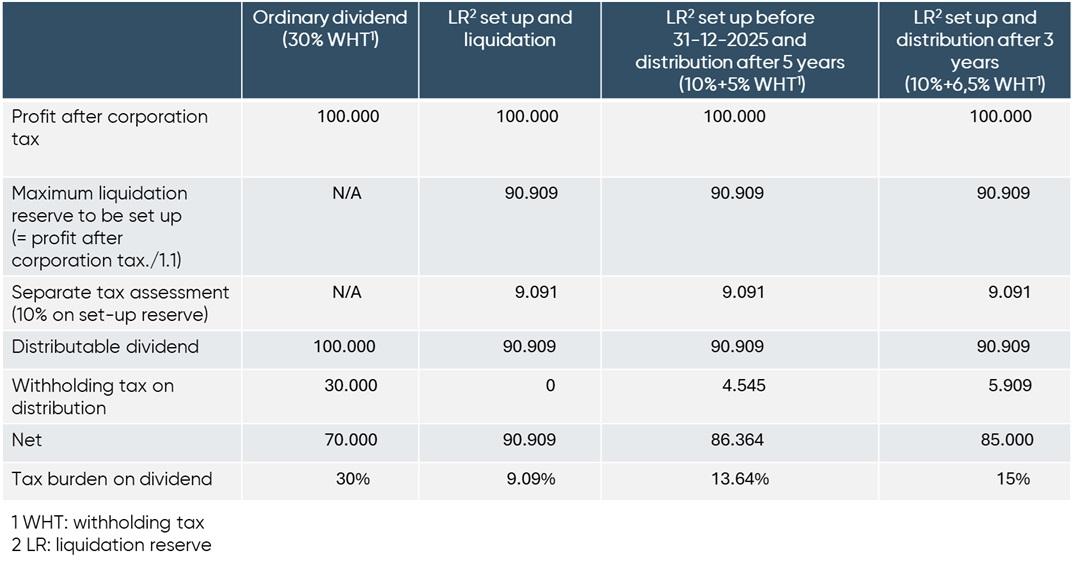
If a liquidation reserve is created, an additional 10% corporation tax is payable on the amount of the reserve. In exchange, the reserve can be distributed later at a favourable tax rate. The liquidation reserve regime was amended by the Programme Act of 18 July 2025 and the Programme Act of 30 May 2026. Under this legislation, a distinction must be made between liquidation reserves created before 31 December 2025 and reserves created after that date.
Upon liquidation, no further tax is payable on the liquidation reserves, regardless of the date of creation and regardless of whether any waiting period has been observed. Please note that the intention cannot be to liquidate a company holding liquidation reserves in order to, shortly thereafter, set up another company with (almost) the same object. A specific anti-abuse provision has also been implemented in this context. If a company is liquidated and the shareholder receives the liquidation reserves tax-free into their private assets, those amounts may still be taxed as taxable dividends (at 30%) if it transpires that, within three years of the liquidation, that shareholder directly or indirectly holds the position of company manager in a company carrying out the same or similar activities as the company that distributed the liquidation reserves. However, the presumption of abuse can be rebutted on non-tax grounds.
For liquidation reserves created before 31 December 2025, business owners will need to carefully assess what would be best in their specific situation:
Many factors come into play here: how quickly and for what purpose the entrepreneur needs the money for their personal use; what alternative funding options are available from their private assets, etc.
Bear in mind that a FIFO (first in, first out) principle applies when distributing liquidation reserves. If you decide to distribute liquidation reserves that are less than five years old, the reserves that are four years old must be distributed first. However, you may be able to distribute those reserves within a few months at (only) 5% withholding tax (once they have been retained within the company for five years).
The Programme Act of 18 July 2025 abolished the 20% rate for shares issued after 31 December 2025.
Under the Programme Act of 30 May 2026, the concessionary rate will increase from 15% to 18% for dividend payments made on or after 1 July 2026.
In summary, dividends on qualifying shares issued before 1 January 2026 are therefore subject to the following withholding tax rates:
Dividend payments made before 1 July 2026 are still subject to the rate of 15%.
Dividends on qualifying shares issued on or after 1 January 2026 are subject to the following withholding tax rates:
It may therefore be tempting or even appropriate to pay out another dividend before 1 July 2026 under the VVPRbis scheme, while the 15% withholding tax rate still applies.
However, when it comes to the (accelerated) payment of a dividend – apart from the rate increase – there are a number of other questions to consider, for example:
We recommend expressing the potential rate benefit of an accelerated payment not only in percentage terms but also in cash terms, and weighing that benefit against any other potential consequences of a decision. Of course, the company will also have to follow the appropriate company law procedure (i.e. general meeting, special general meeting, net asset test, liquidity test, etc.).
When a Belgian company receives dividends from another company, the dividend it receives can be exempted from corporation tax by applying the ‘dividends received deduction’ (DRD). For this tax deduction to be applied, three cumulative conditions must be met at the time the dividend is declared:
A stricter holding size condition applies for large companies from assessment year 2026 onwards. If the recipient of the dividends is a large company, a participating interest (holding) of less than 10% but with an acquisition value of at least 2 500 000 euros will moreover have to take the form of a ‘financial fixed asset’ to be eligible for the dividends received deduction.
For the term ‘financial fixed asset’, reference is made to the meaning assigned to it in accounting legislation. This implies that the shares held should be included under:
Entering the shareholding under these items implies that the company wishes to have a lasting and specific connection with the company in which it invests and therefore does not see the participating interest purely as an investment.
Since the conditions applying for the dividends received deduction and the exemption from capital gains on shares in corporation tax are similar, there is an additional consequence for large companies. Capital gains on shares can only be exempted (for shareholdings of less than 10% and subject to some specific exceptions) if the acquisition value of the shares is at least 2.5 million euros and they are recorded as financial fixed assets.
This stricter holding size condition will apply with immediate effect from assessment year 2026! Changes made between 3 February 2025 and the closing date of the financial year will not be accepted unless it can be demonstrated that the change was motivated by economic (i.e. non-tax-related) considerations.
For small companies, the conditions applying for the dividends received deduction and capital gains exemption on shares will not change. A company is deemed to be small if at the balance sheet date it does not exceed more than one of the following criteria:
Exceeding more than one of these limits will only have consequences if it occurs during two consecutive financial years. When assessing the criteria, not only the data of the company itself but also of ‘affiliated companies’ must be taken into account.
A DRD Bevek is an investment company that has to meet a number of conditions. For example, a DRD Bevek must distribute at least 90% of the net income it receives.
A DRD Bevek offers a tax-efficient alternative to equity investments, as it allows the investor to obtain the exemption of dividends and capital gains on shares without having to meet the strict holding size condition and holding period condition (see above). However, the DRD Bevek must meet the taxation condition. In other words, the DRD Bevek will have to invest in shares of companies that meet the taxation condition. A DRD Bevek can receive both qualifying and non-qualifying income. Qualifying income is income (dividends, capital gains) from shares that meet the taxation condition. The ratio of qualifying income to total income (qualifying + non-qualifying) is calculated on an ongoing basis and produces the ‘DRD coefficient’.
Specifically, the company investor can:
However, a DRD Bevek is required to deduct the appropriate withholding tax when it pays or declares a dividend. That is in contrast to a repurchase or liquidation bonus, which is not subject to withholding tax. In principle, the deducted withholding tax can be offset against corporation tax and reclaimed by the company-investor.
Under the Miscellaneous Provisions Act, from assessment year 2026, offsetting withholding tax against corporation tax is only possible for dividends received from a DRD Bevek insofar as the receiving company has paid the minimum remuneration for company managers in the income year in which it receives dividends from the DRD Bevek. Under the draft legislation, the minimum managerial remuneration would be raised to 50 000 euros (indexed). If no minimum remuneration is granted, failure to offset the withholding tax will generally result in the total tax burden on the dividend received exceeding the standard corporation tax rate of 25%. In such case, the company can, however, choose not to apply the DRD deduction to the dividend received, which means the coupon will be subject in full to corporation tax and the withholding tax can be offset. The total tax on the coupon would then amount to a maximum of 25% (similar to an ‘ordinary’ Bevek). The Finance Minister expressly endorsed this option in the Parliamentary Finance Committee.
You should not consider this news item an investment recommendation or advice.

Our fries, waffles and chocolates are not just some of the best products in Belgium, they’re also famous throughout the world. And now we’re proud to add our app to that illustrious list. But don’t take our word for it. Independent research company Sia Partners thinks so too after naming KBC Brussels Mobile ‘Best Banking App in Belgium’.

'I’ve just bought a house and KBC Brussels Mobile really proved its worth here. I found solutions to make our home more sustainable and energy efficient. And to top things off, I spotted a Kate Deal that gave me a discount on exactly the DIY materials I needed!"

"When my wallet was stolen, Kate was there to help me block my cards and apply for new ones. Best of all, my new cards were accessible right away in KBC Brussels Mobile which meant I could go shopping the same day as planned!"

"I spent last weekend at the seaside with the girls. We kept track of our shared expenses in KBC Brussels Mobile and later simply split them so everyone could pay their share of the bill. Not only that, we also picked up a tasty Kate Deal for the restaurant we had dinner at!"

‘I was involved in an accident with my car last week. Fortunately, I was able to report the damage really quickly using KBC Brussels Mobile and could even upload photos. Now my car’s in the garage for repairs, I manage my transport needs with KBC Brussels Mobile just as quickly too.’