

‘Arizona’ Coalition Agreement: practical details of tax plans for investors
Update 30-07-2026
On this page, we take a closer look at the further details of the tax plans and how they will affect investors, both private individuals and entrepreneurs.
Liquidation reserves (update)
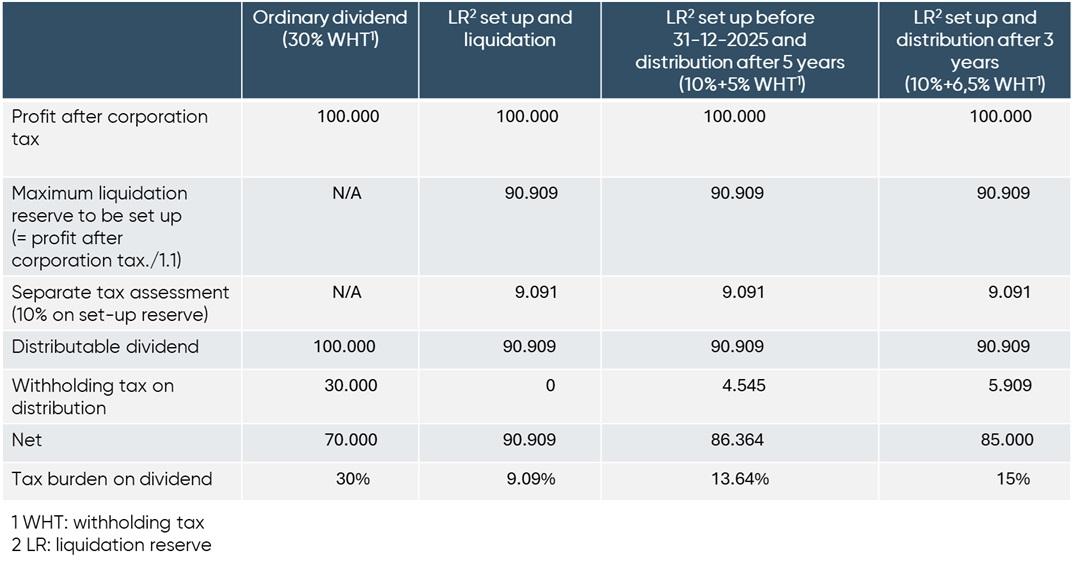
If a company pays dividends to shareholders who are natural persons, in principle 30% withholding tax is applicable. Using the VVPRbis tax reduction scheme (see below) and liquidation reserves, this tax burden can be reduced under certain conditions.
If a liquidation reserve is created, an additional 10% corporation tax is payable on the amount of the reserve. In exchange, the reserve can be distributed later at a favourable tax rate. The liquidation reserve regime was amended by the Programme Act of 18 July 2025 and the Programme Act of 30 May 2026. Under this legislation, a distinction must be made between liquidation reserves created before 31 December 2025 and reserves created after that date.
- Liquidation reserves created before 31 December 2025 can still be distributed (under the original regime) after a waiting period of five years at a withholding tax rate of 5%. Total tax burden: 13.64%.
- It is also possible to opt for a three-year waiting period before distribution of the liquidation reserves. In that case, however, 6.5% withholding tax will have to be paid upon distribution. Net tax burden: 15%.
- If the reserve is distributed before expiry of the three-year period, a withholding tax rate of 20% applies.
- The increase in the withholding tax rate does not apply to these previously accumulated liquidation reserves.
- For reserves created on or after 31 December 2025 (assessment year 2026 onwards), the waiting period is always three years.
- In case of distribution after expiry of the waiting period, the withholding tax rate is 9.8%, bringing the total tax burden to 18% (see table below).
- The distribution of liquidation reserves within the three-year waiting period should be avoided at all costs, as this would result in the payment of both the tax due upon creation and the additional 30%.
Upon liquidation, no further tax is payable on the liquidation reserves, regardless of the date of creation and regardless of whether any waiting period has been observed. Please note that the intention cannot be to liquidate a company holding liquidation reserves in order to, shortly thereafter, set up another company with (almost) the same object. A specific anti-abuse provision has also been implemented in this context. If a company is liquidated and the shareholder receives the liquidation reserves tax-free into their private assets, those amounts may still be taxed as taxable dividends (at 30%) if it transpires that, within three years of the liquidation, that shareholder directly or indirectly holds the position of company manager in a company carrying out the same or similar activities as the company that distributed the liquidation reserves. However, the presumption of abuse can be rebutted on non-tax grounds.
For liquidation reserves created before 31 December 2025, business owners will need to carefully assess what would be best in their specific situation:
- Accelerated distribution at a withholding tax rate of 6.5% (if there are liquidation reserves that were created three or four years ago) or
- Wait until the five-year period has expired and then distribute them at a withholding tax rate of 5%
Many factors come into play here: how quickly and for what purpose the entrepreneur needs the money for their personal use; what alternative funding options are available from their private assets, etc.
Bear in mind that a FIFO (first in, first out) principle applies when distributing liquidation reserves. If you decide to distribute liquidation reserves that are less than five years old, the reserves that are four years old must be distributed first. However, you may be able to distribute those reserves within a few months at (only) 5% withholding tax (once they have been retained within the company for five years).
VVPRbis (update)
- 30% on distribution of profits for the financial year of incorporation (or capital increase) and for the following financial year
- 20% on distribution of profits for the second financial year after the year of incorporation (or capital increase)
- 15% on distribution of profits for the third financial year after the year of incorporation (or capital increase) and for all subsequent financial years
The Programme Act of 18 July 2025 abolished the 20% rate for shares issued after 31 December 2025.
Under the Programme Act of 30 May 2026, the concessionary rate will increase from 15% to 18% for dividend payments made on or after 1 July 2026.
In summary, dividends on qualifying shares issued before 1 January 2026 are therefore subject to the following withholding tax rates:
- 30% on distribution of profits for the financial year of incorporation (or capital increase) and for the following financial year
- 20% on distribution of profits for the second financial year following the financial year of the incorporation (or capital increase)
- 18% on distribution of profits for the third financial year following the financial year of the incorporation (or capital increase) and for all subsequent financial years
Dividend payments made before 1 July 2026 are still subject to the rate of 15%.
Dividends on qualifying shares issued on or after 1 January 2026 are subject to the following withholding tax rates:
- 30% on distribution of profits for the financial year of incorporation (or capital increase) and for the two subsequent financial years
- 18% on distribution of profits for the third financial year following the financial year of the incorporation (or capital increase) and for all subsequent financial years
It may therefore be tempting or even appropriate to pay out another dividend before 1 July 2026 under the VVPRbis scheme, while the 15% withholding tax rate still applies.
However, when it comes to the (accelerated) payment of a dividend – apart from the rate increase – there are a number of other questions to consider, for example:
- Is there a need to hold funds in private assets?
- Does the company qualify as a ‘family firm’ (which can be inherited at a flat rate of 3%)?
- Will the distribution affect the possibility to apply the reduced corporation tax rate?
We recommend expressing the potential rate benefit of an accelerated payment not only in percentage terms but also in cash terms, and weighing that benefit against any other potential consequences of a decision. Of course, the company will also have to follow the appropriate company law procedure (i.e. general meeting, special general meeting, net asset test, liquidity test, etc.).
Dividends Received Deduction: stricter holding size condition for large companies (update)
When a Belgian company receives dividends from another company, the dividend it receives can be exempted from corporation tax by applying the ‘dividends received deduction’ (DRD). For this tax deduction to be applied, three cumulative conditions must be met at the time the dividend is declared:
- The taxation condition means that the dividends received must relate to ‘good’ shares, i.e. shares held in companies that are subject to ‘normal’ (and therefore ‘final’) taxation on their profits in the country where they are established. If the company distributing the dividend pays little or no tax on its profits in the country in which it is established (for example in a tax haven), the dividend received cannot be exempted.
- The holding period condition means that dividends received must relate to shares that are or were held in full ownership for a continuous period of at least one year.
- The holding size condition means that the company receiving the dividend must hold a participating interest in the distributing company of at least 10% of the capital or with an acquisition value of at least 2 500 000 euros.
A stricter holding size condition applies for large companies from assessment year 2026 onwards. If the recipient of the dividends is a large company, a participating interest (holding) of less than 10% but with an acquisition value of at least 2 500 000 euros will moreover have to take the form of a ‘financial fixed asset’ to be eligible for the dividends received deduction.
For the term ‘financial fixed asset’, reference is made to the meaning assigned to it in accounting legislation. This implies that the shares held should be included under:
- ‘Participating interests in affiliated entities’
- ‘Participating interests in companies linked by participating interests’ or
- ‘Participating interests in other financial fixed assets’
Entering the shareholding under these items implies that the company wishes to have a lasting and specific connection with the company in which it invests and therefore does not see the participating interest purely as an investment.
Since the conditions applying for the dividends received deduction and the exemption from capital gains on shares in corporation tax are similar, there is an additional consequence for large companies. Capital gains on shares can only be exempted (for shareholdings of less than 10% and subject to some specific exceptions) if the acquisition value of the shares is at least 2.5 million euros and they are recorded as financial fixed assets.
This stricter holding size condition will apply with immediate effect from assessment year 2026! Changes made between 3 February 2025 and the closing date of the financial year will not be accepted unless it can be demonstrated that the change was motivated by economic (i.e. non-tax-related) considerations.
For small companies, the conditions applying for the dividends received deduction and capital gains exemption on shares will not change. A company is deemed to be small if at the balance sheet date it does not exceed more than one of the following criteria:
- Annual average number of employees: 50
- Annual turnover excluding VAT: 11 250 000 euros
- Balance sheet total: 6 000 000 euros
Exceeding more than one of these limits will only have consequences if it occurs during two consecutive financial years. When assessing the criteria, not only the data of the company itself but also of ‘affiliated companies’ must be taken into account.
DRD Bevek (update)
A DRD Bevek is an investment company that has to meet a number of conditions. For example, a DRD Bevek must distribute at least 90% of the net income it receives.
A DRD Bevek offers a tax-efficient alternative to equity investments, as it allows the investor to obtain the exemption of dividends and capital gains on shares without having to meet the strict holding size condition and holding period condition (see above). However, the DRD Bevek must meet the taxation condition. In other words, the DRD Bevek will have to invest in shares of companies that meet the taxation condition. A DRD Bevek can receive both qualifying and non-qualifying income. Qualifying income is income (dividends, capital gains) from shares that meet the taxation condition. The ratio of qualifying income to total income (qualifying + non-qualifying) is calculated on an ongoing basis and produces the ‘DRD coefficient’.
Specifically, the company investor can:
- Receive capital gains exemption on sale of shares of a DRD Bevek in proportion to the DRD coefficient. Under the Miscellaneous Provisions Act, exempt ‘capital gains’ realised on shares of DRD Beveks are subject to 5% tax. In practice, however, the DRD Bevek will almost always buy back (and immediately cancel) its own shares. In that case, the company-investor does not realise a capital gain on shares, but receives a redemption bonus (= dividend), to which it can (permanently) apply the DRD deduction. The 5% assessment does not apply to this redemption bonus.
- Claim the DRD deduction on dividends distributed by the DRD Bevek in proportion to the DRD coefficient.
However, a DRD Bevek is required to deduct the appropriate withholding tax when it pays or declares a dividend. That is in contrast to a repurchase or liquidation bonus, which is not subject to withholding tax. In principle, the deducted withholding tax can be offset against corporation tax and reclaimed by the company-investor.
Under the Miscellaneous Provisions Act, from assessment year 2026, offsetting withholding tax against corporation tax is only possible for dividends received from a DRD Bevek insofar as the receiving company has paid the minimum remuneration for company managers in the income year in which it receives dividends from the DRD Bevek. Under the draft legislation, the minimum managerial remuneration would be raised to 50 000 euros (indexed). If no minimum remuneration is granted, failure to offset the withholding tax will generally result in the total tax burden on the dividend received exceeding the standard corporation tax rate of 25%. In such case, the company can, however, choose not to apply the DRD deduction to the dividend received, which means the coupon will be subject in full to corporation tax and the withholding tax can be offset. The total tax on the coupon would then amount to a maximum of 25% (similar to an ‘ordinary’ Bevek). The Finance Minister expressly endorsed this option in the Parliamentary Finance Committee.
You should not consider this news item an investment recommendation or advice.